
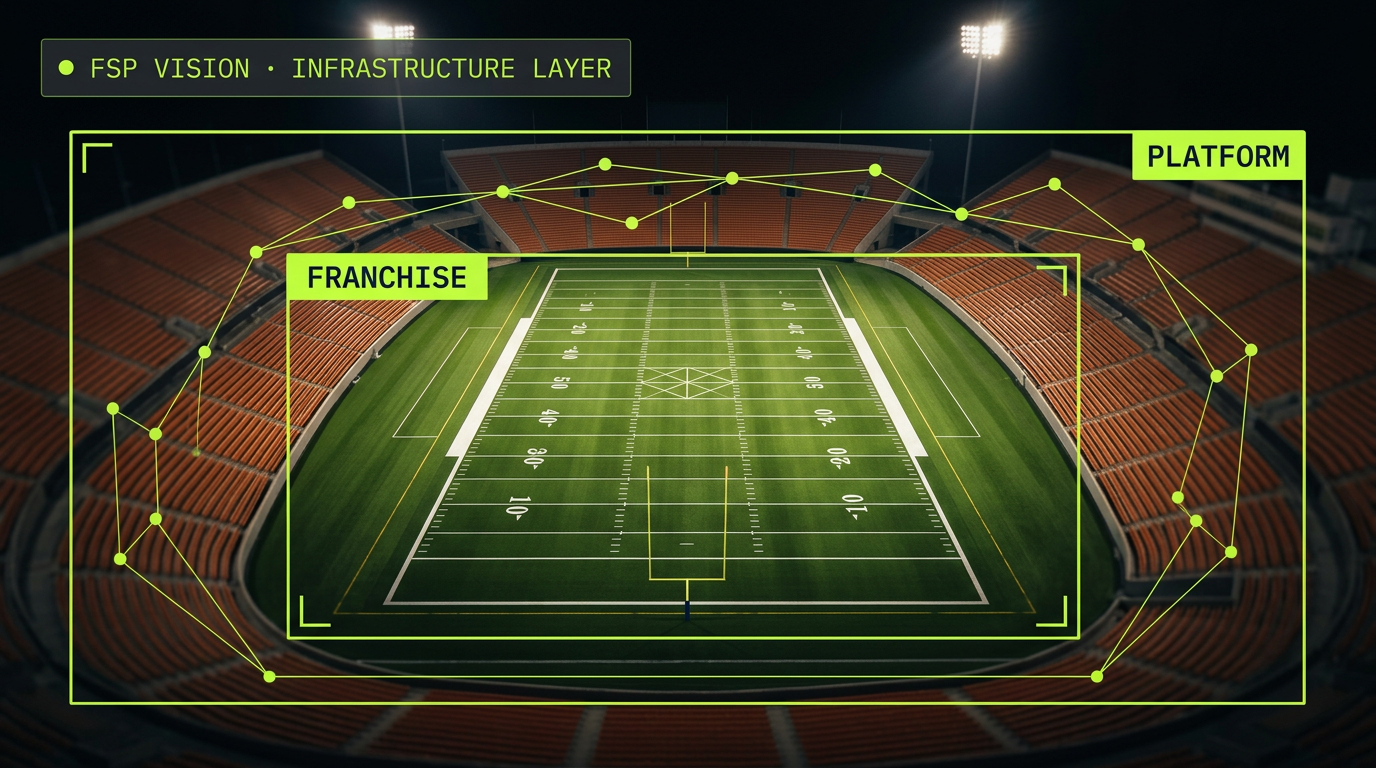
The money found the wrong layer first
In February 2026, KKR agreed to acquire Arctos Partners for $1.4 billion initial consideration (up to $1.95 billion with earnouts through 2033), absorbing the only firm approved for multi-team ownership across all five major US leagues. Arctos held $15 billion in AUM at acquisition, with portfolio stakes including the Buffalo Bills (10%, December 2024), Golden State Warriors, Los Angeles Dodgers, Liverpool FC, and Paris Saint-Germain. The NFL only opened institutional PE minority ownership in August 2024 (31-1 owner vote). Rules cap stakes at 10% per franchise, require passive non-voting positions, and mandate a minimum six-year hold.
The signal is not that team ownership is weak. The signal is that the control layer is closed, while the participation layer is still open.
Franchises became financial assets, then access narrowed
The Ross-Arctos Sports Franchise Index shows Big 4 North American franchise values compounding at 14.9% annually over 10 years versus the S&P 500 at 12.5% (as of March 31, 2025). Over 20 years: 14.4% versus S&P 500 at 10.7%. Over 60 years: 13.0% CAGR. NFL average franchise value reached $7.1 billion in 2025, up 25% year-over-year, with all 32 teams exceeding $5 billion for the first time.
| Rule | Current structure |
|---|---|
| NFL cap | 10% per franchise, passive, non-voting, six-year minimum hold |
| NBA/NHL/MLB pattern | Minority fund stakes with no operating authority |
| Investor implication | Exposure to appreciation, not control of the product |
The open market is the player economy
250 million Americans participated in at least one sport, fitness, or leisure activity in 2025 (SFIA, March 2026), the first time that milestone was recorded. 158.8 million are core participants, meaning frequent and committed. The direct participation economy generates $196 billion annually in club memberships, match fees, and league registrations (GIS Sport, 2025), within a broader $355 billion participation contribution to the US sports industry. Amateur sports tourism alone generated $52.2 billion in direct spending in 2025, more economic impact than spectator sports events in the same survey year (Sports ETA, 2025).
The better sports businesses sold the rails
Live Nation's market cap reached approximately $38 to $39 billion in June 2026, nearly three times the Dallas Cowboys ($13 billion), the most valuable sports franchise on Earth. Live Nation's 2025 revenue of $25.2 billion exceeds the estimated $22 billion distributed to all 32 NFL teams combined. Electronic Arts' market cap of approximately $50.6 billion exceeds every individual franchise valuation globally; EA pays the NFL an estimated $150 million annually in licensing while generating approximately $700 million from Madden NFL alone. EA Sports FC 25 (2024 release) became the best-selling sports game in US history within months of launch.
Sportradar reported FY2025 revenue of EUR 1.29 billion, up 17% year-over-year, with adjusted EBITDA of EUR 297 million and a 23% margin. The company guided for EUR 1.557 to 1.582 billion in 2026 revenue, representing 23 to 25% growth. Genius Sports reported FY2025 revenue of $669.5 million, up 31% year-over-year, with adjusted EBITDA of approximately $136 million at a 20% margin.
Software consolidation is happening above the player, not around the player
US sportsbook revenue reached a record $16.96 billion in 2025, up 24% year-over-year (AGA / ESPN, January 2026). Total handle exceeded $165 billion across 38 states and DC. Flutter Entertainment, FanDuel's parent, reported FY2025 group revenue of $16.38 billion with US adjusted EBITDA up 82% to $922 million. FanDuel held 44% US gross gaming revenue market share in December 2024.
| Layer | Typical owner | Gap |
|---|---|---|
| Registration | League and club software | Stops after sign-up |
| Coaching | Local operators and specialist apps | Does not follow the player across sports |
| Courts and facilities | Municipal, club, and private venue systems | Inventory is not unified |
| Player identity | Mostly absent | No durable sports wallet for the participant |
FSP's relevance is the transaction mechanism
The infrastructure prize is not a prettier content feed. It is a participation ledger: who plays, where they play, what they pay, how they improve, and how the revenue moves between players, venues, coaches, leagues, and sponsors.
That is why the next billion-dollar sports company can be built without a team. It can sit underneath many sports at once, monetize repeat participation instead of scarce ownership, and compound with every match, court booking, league entry, skill challenge, and fan-funded prize pool.
The control layer is scarce. The participation layer is recurring.
LSC Research, June 2026 perspectiveSources and methodology
All figures are drawn from the fresh June 2026 research run and source-recency gate used by the LSC Research pipeline.
- BusinessWire: KKR to Acquire Arctos (2026)
- Sportico: KKR Buys Arctos in $1.4B Deal (2026)
- Bloomberg: KKR to Acquire Arctos (2026)
- Akin Gump 2026 Perspectives in Private Equity Sports (2026)
- Akin Gump 2025 Perspectives in Private Equity Sports (2025)
- Ross-Arctos Sports Franchise Index, Michigan Ross School of Business (2025)
- Sportico NBA Team Values 2025 (Warriors $11.33B, avg $5.51B) (2025)
- Sportico MLB Team Values 2025 (2025)
- Forbes / CNBC NFL Franchise Values 2025 (avg $7.1B) (2025)
- Sportico: Premier League Valuations 2025 (2025)
- Apollo Sports Capital: Atletico de Madrid Press Release (2025)
- NFL.com: Owners Vote to Allow Private Equity Funds August 2024 (2024)
- Sportico: NBA Private Equity Rules Loosened to 8 Teams Per Fund (2025)
- SFIA 2026 Topline Participation Report (2026)