
A global tournament proved competition doesn't need a stadium to scale
The Esports World Cup 2026 opened July 6 at the Paris Expo Porte de Versailles, its first edition outside Saudi Arabia, and ran through August 23 with a record $75 million prize pool spread across 25 tournaments and 24 games, according to GameDaily and PR Newswire in 2026. More than 2,000 players from over 100 countries and 200 clubs competed, proof that a global tournament can move cities entirely and still add scale rather than lose it. The tournament's roster, drawn from six continents into a single bracket, shows the reach a participation format can build without travel costs, reach that most participation sports still can't match even though spectator sports already lean on federations to organize recruiting across borders.
That $75 million did not arrive overnight. The prize pool ran roughly $60 million to $62.5 million at the inaugural Riyadh event in 2024, climbed to $71.5 million in 2025, and reached $75 million for the 2026 move to Paris, per Wikipedia and Al Majalla. A companion Esports Nations Cup launched in 2026 alongside it with its own $20 million allocation, meaning the format is expanding on two tracks at once rather than plateauing after a strong debut. That steady climb is the kind of growth curve a market usually sees only once it stops depending on one host country's budget.
Riyadh needed a Public Investment Fund backed strategy targeting $13.3 billion in GDP contribution to build the machine behind the event, per PIF and SportBusiness reporting from 2025. But the tournament's ability to relocate to Paris without losing scale is the part that matters here: the competition layer is portable in a way a stadium anchored league never is, which is exactly the property a low infrastructure market needs. That portability is the mechanism this report argues could travel to sports far outside gaming.
Traditional sport still gatekeeps by geography and infrastructure cost
Traditional sport still charges admission at the door. Thirteen AFCON players developed through Senegalese academies generated just 100,000 euros in transfer fees for the academies that trained them, according to Al Jazeera and Outlook India in 2025. The European clubs that later acquired those same players resold them for a combined 81.2 million euros, and the players went on to generate 411 million euros in transfer value over their careers, value the academies of origin never touched. That gap, a few thousand euros captured against hundreds of millions generated, is the arithmetic an open platform would need to close.
The filter starts before a scout ever looks, and it starts at home. Academy fees in South Africa run between R10,000 and R200,000 a year, roughly $550 to $11,000, according to 2025 reporting from Campus Cybercafe and Outlook India, a price that filters out talent on family finances alone before a coach ever tests ability on a field, regardless of how many goals that player might score somewhere else.
Nigeria shows the same gate at the national level. Reporting on the country's sports sector describes stadiums and training centers hindered by limited financing, with even newly built complexes declining rapidly from poor maintenance, per Within Nigeria in 2025. A national study using the TDEQ-9S framework found family finances, facility access, and lack of regular competition among the top barriers young athletes face; Lagos will host the first National Intermediate Games in October 2026 to patch the gap between youth competition and elite pathways, a gap a participation platform could close continuously instead of once a year.
The phone in an average Lagos pocket already clears that gate
None of that scarcity exists on a phone screen, which is the entire point of comparing the two pipelines. Africa's gaming market reached $2.29 billion in 2026, and more than 95 percent of the continent's 349 million gamers play on mobile, with 87 percent on smartphones specifically, according to Mordor Intelligence in 2026. There is no academy fee standing between a player and the device that already sits in their pocket, and no facility maintenance budget required to keep it running.
Nigeria's numbers show why this matters for the talent argument specifically. Mobile penetration hit 51 percent and gaming revenue reached roughly $300 million in 2026, while smartphone shipments grew 8 percent year over year in the first quarter, driven by $200 to $299 devices running 4G and 5G, according to Ecofin Agency and Technext in 2026. A phone that costs a few hundred dollars now does what an academy costing thousands could not: put a player in front of a global matchmaking system. That gap between a phone's price and an academy's fee is the argument in miniature.
Mobile publishers built the qualifier ladder traditional sport never finished
Mobile publishers have already built the qualifier ladder that traditional sport is still missing, and they built it without asking anyone to travel far to prove themselves. PUBG Mobile's first Africa Cup gave Sub Saharan African squads a direct qualification route to the PUBG Mobile Global Championship, and Infinix partnered with the game in 2024 to run a national campus competition in Nigeria that sent four University of Lagos students to the global tournament, per Carry1st and PR Newswire reporting from 2025.
Garena's Free Fire runs the same structure at a larger scale: standing regional professional leagues in Brazil, Indonesia, Thailand, the Middle East, Africa, and Pakistan feed into the Free Fire World Series and Continental Series, and the company launched a Global Talent Developer programme in 2025 to formalize local community pipelines into that structure, according to PocketGamer.biz and Esports Insider. Neither publisher needed a stadium or an academy fee to build a path from a local server to a world final.
The money is engineered to reach the competitor before the federation
The Esports Nations Cup's structure shows where the money is designed to land. Of its $45 million financial commitment, $20 million goes directly to players and coaches on a standardized scale, first place at $50,000 per player, second at $30,000, third at $15,000, with coaches paid the same as players at each finish, according to PR Newswire and Sheep Esports in 2026. A further $5 million funds club release incentives, paid on top of a player's own prize rather than deducted from it, and the remaining $20 million goes to a federation development fund.
The structural point is that the largest single tier goes to the individual competitor before any federation or club takes a cut, a sharp contrast with the academy model where value flows upward first. Southeast Asia already shows what a decade of that arrangement produces: Filipino esports players have collectively earned $27.4 million across 1,924 players and Indonesian players $21.9 million across 2,654, largely on mobile titles like Mobile Legends: Bang Bang, without a domestic professional sports infrastructure comparable to Western academies, per Esports Earnings and Digest Africa.
Chess.com's growth shows what happens when geography stops filtering players
Chess.com is the clearest existing proof of what happens when geography stops filtering players. The platform passed 200 million registered members in April 2025, having doubled its user base in a little over two years, and has since reached 250 million, according to Chess.com and ChessBase. The United States and India together account for 64 million of those members, about a third of the total, with India's surge tied directly to Grandmaster Gukesh Dommaraju becoming the youngest world chess champion in history in 2024.
Chess federations describe Africa as having the greatest remaining growth potential in the world, according to FIDE, precisely because so little of its player base has been onboarded yet, not because the talent or interest is absent. That is the same population the esports and mobile gaming numbers point to, and the same population a participation platform in traditional sport would need to reach to find the next player a Senegalese or Nigerian academy fee would otherwise have priced out.
AI scouting apps are the missing bridge back to traditional sport
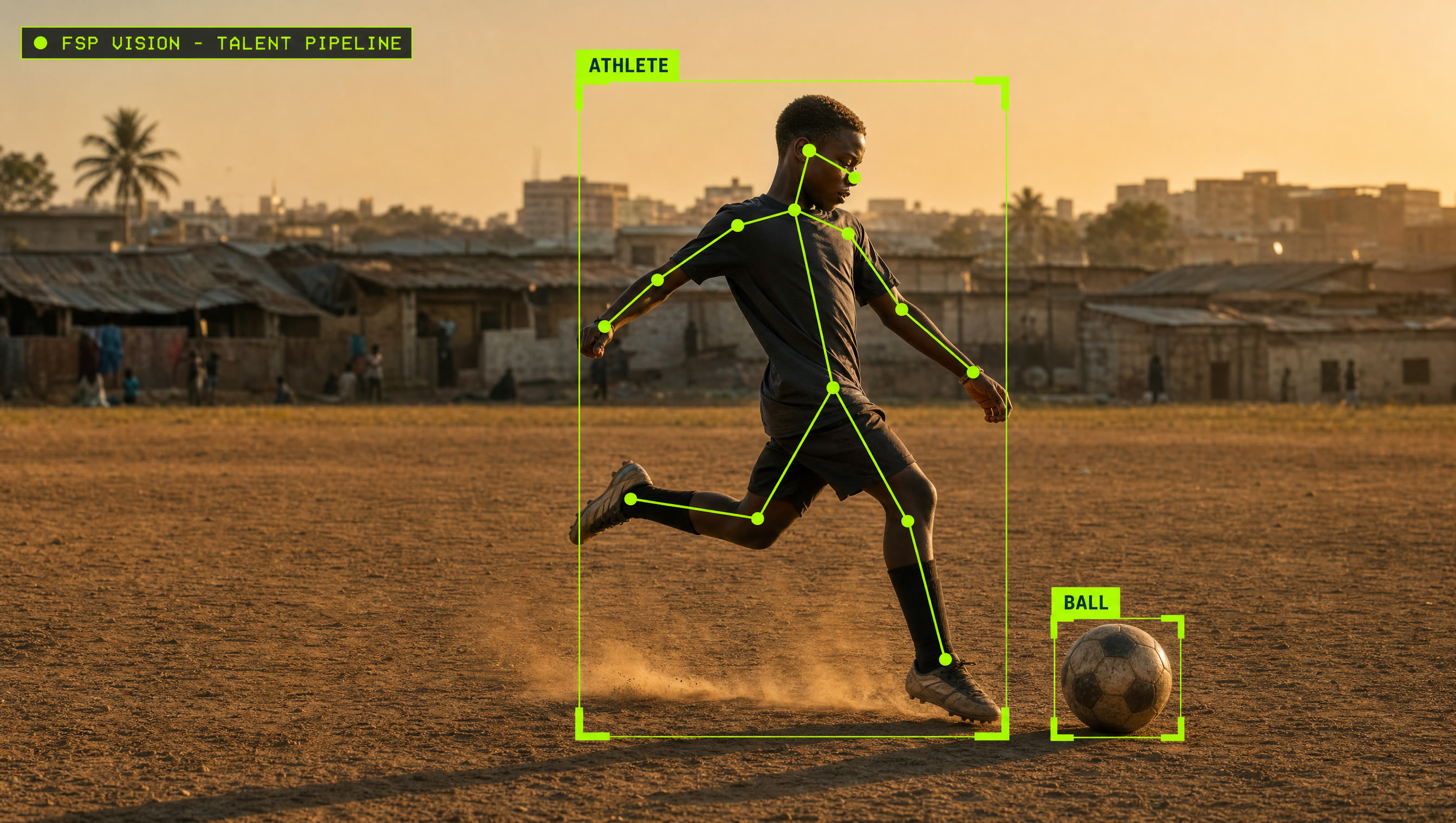
The bridge back to traditional sport already exists in early form. The aiScout platform, built by ai.io and validated with Kingston University's sport science faculty, lets a player with nothing more than a smartphone and a football complete standardized drills, stepovers, press ups, sprint times, that are scored and shared with clubs including Chelsea, Burnley, and MLS sides, according to League of Africa and Medical Xpress in 2026. It has already produced trial offers for amateur players discovered this way, with success stories reported across African countries.
aiScout sits alongside newer platforms like Afriskaut and Soccerlytica, which verify grassroots and academy talent directly from the field rather than through an agent's referral or a paid trial, per France24's 2026 reporting. That is the same mechanism the Esports World Cup and Free Fire's regional leagues already run at scale: a low barrier to entry, global matchmaking, and a direct line from a local drill to a global tournament, minus the academy fee that currently decides who gets seen.
A global participation platform, not a bigger academy, is what finds the next player
The Esports World Cup did not need a stadium to grow from roughly $60 million in Riyadh to $75 million in Paris in three years, and Chess.com did not need a single physical location to add 50 million members in about a year, per Wikipedia and Chess.com's 2025 figures. Traditional sport's pipeline in markets like Nigeria still runs on a stadium and academy model that a national study flagged for family finances, facility access, and missing competition as its central barriers, the same model that captured 100,000 euros from players later worth 411 million.
A platform built on the mechanics already visible in esports, a low cost of entry through a $200 to $299 smartphone, global matchmaking through a qualifier ladder like PUBG Mobile's Africa Cup, and prize money paid to the competitor first as the Esports Nations Cup now does, would not replace the academy. It would route around the fee that keeps that model from ever reaching 349 million gamers and the athletes among them, in Lagos and every market like it, before a European club gets there first.
Sources and methodology
All figures are generated through the LSC Research source-recency gate and reviewed before publication.
- GameDaily, Esports World Cup 2026 Opens In Paris (2026)
- PR Newswire, Esports World Cup 2026 Opens in Paris (2026)
- Wikipedia, 2026 Esports World Cup (2026)
- PIF, How PIF is supercharging the new golden age of gaming (2025)
- SportBusiness, Explained: The Saudi-backed non-profit orchestrating esports (2025)
- Al Jazeera, How Senegal became genuine World Cup 2026 contenders, at a cost (2026)
- Campus Cybercafe, Top Football Academies in South Africa and Their Fees (2025)
- Within Nigeria, No Place to Play (2025)
- Johan Cruyff Institute, sports industry in Nigeria infrastructure focus (2025)
- Mordor Intelligence, Africa Gaming Market Report (2026)
- Technext, Nigeria smartphone shipments Q1 2026 (2026)
- Carry1st, PUBG Mobile Africa Cup Debuts (2025)
- PR Newswire, Infinix and PUBG Mobile Bridge Talent and Opportunity (2025)
- PocketGamer.biz, Garena unveils 2025 Free Fire esports roadmap (2025)
- Chess.com, Chess.com Reaches 250 Million Members (2025)
- FIDE, The growth of chess in Africa (2026)