
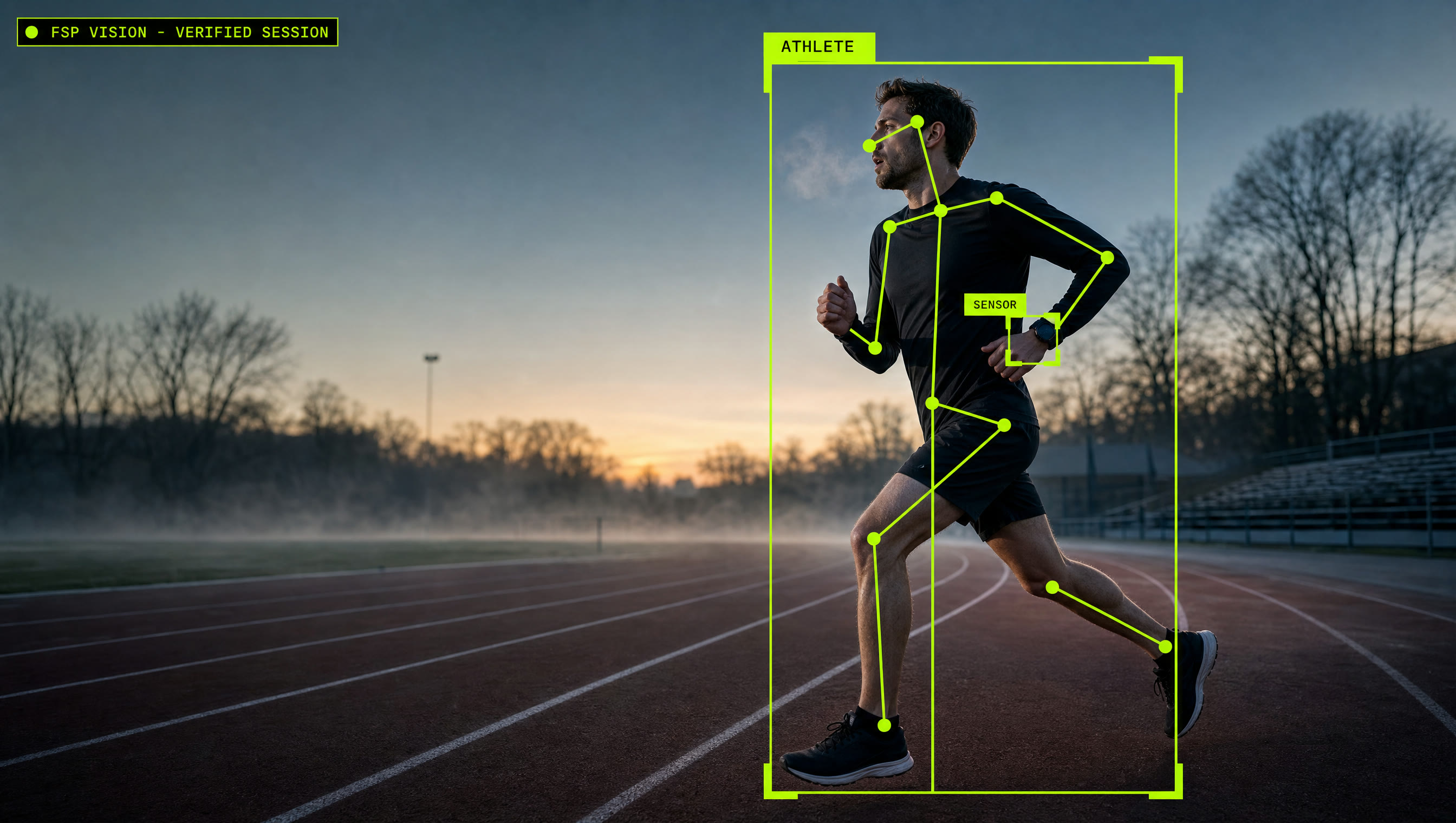
England's World Cup vests prove capture at scale is already solved
England's performance staff wired players with Sony's STATSports APEX vests during FIFA World Cup 2026 matches, the first live in match GPS deployment at a World Cup, according to Sports Video Group in 2026. Pods sit between the shoulder blades and sample position at 10Hz, streaming a sideline dashboard that tracks high speed running distance, sprint load, and acceleration and deceleration as the game unfolds. For the first time, a national team's medical staff could watch physiological strain accumulate in real time, not reconstruct it from a postgame report.
Twelve of the 48 competing nations wore STATSports kit, meaning roughly a quarter of the field now treats sprint load and heart rate response as a routine part of match preparation, per Sports Video Group 2026. That is elite technology, expensive and proprietary to each federation's performance department, built to help a coach make a substitution decision at halftime. It was never built to answer a different question: whether an insurer, months later, can trust that the data describes what actually happened on the pitch.
That capability already scaled across sport, and stayed locked inside it
STATSports supplies GPS athlete monitoring to Manchester United, Manchester City, Liverpool, Arsenal, Juventus, and Paris Saint Germain, along with national federations including Brazil, England, and US Soccer, New Zealand's All Blacks, the NFL's Washington Commanders, and the NBA's Chicago Bulls, per the company's own disclosures in 2026. Every one of those relationships produces rich physiological telemetry: sprint counts, deceleration loads, positional heat maps, built up over an entire season.
None of it is structured to answer a benefits team's question. GPS telemetry tells a coach how hard an athlete trained; it does not tell an outside party who did the training, when, or whether the session is what it claims to be. That distinction, capture versus verification, is the one insurers keep running into when wearable and self reported data reaches their desk, and it is the distinction that decides whether a data set can survive a premium negotiation.
The wearable data insurers actually see is far less rigorous than a GPS vest
A 2026 review of nine leading consumer fitness trackers found energy expenditure error rates commonly cited between 27 percent and 93 percent depending on the device and the activity, with cycling and resistance training showing the widest gaps, according to Forbes contributor Jesse Pines. That is not a rounding problem. A tracker that misjudges a strength session by nearly half is not a data source an actuary can build a pricing model on.
Even the best performer in the category falls short. A 2025 Ole Miss validation study found the Apple Watch, generally regarded as the most accurate consumer device, still recorded a mean absolute percent error near 28 percent for energy expenditure. That is the device most benefits teams are quietly relying on when they tell an insurer their population is active. Volume of data was never the constraint on underwriting; the accuracy of any single reading is.
Self reported activity gets faked, and vendors already admit it
Even accurate hardware cannot fix a reporting problem. Wellable's 2025 and 2026 guidance to employers catalogs how workers inflate activity data: strapping trackers to ceiling fans, pets, or power tools, or simply keying steps into Apple Health and Google Fit that were never walked. A step count, once it reaches an insurer's spreadsheet, carries no record of how it was produced, who produced it, or whether the device that generated it was ever worn by the person whose name is on the file.
Vendors have already priced in the fraud. TruStep now splits steps into a verified category synced directly from a device and a manual entry category that can be capped or excluded, according to A Step Ahead Challenge's 2025 product documentation. That split is itself an admission: raw wearable feeds cannot be trusted without a second layer that checks them, which is exactly the layer wearables were supposed to make unnecessary in the first place.
Regulators have turned raw wearable collection into a legal liability
Collecting this data is also becoming a legal exposure, not only a quality footnote. The Equal Employment Opportunity Commission published its first fact sheet on workplace wearables on December 19, 2024, warning that employer collection of biometric or activity data through smartwatches and GPS trackers can constitute a medical examination or disability related inquiry under the ADA, and must be stored separately and kept confidential.
The exposure is not theoretical. More than 30 employers were sued in 2024 alone over wellness program incentive structures tied to self reported health data, according to HR Defense Blog's legal analysis. A benefits team weighing whether to hand an insurer a spreadsheet of employee step counts is now weighing that against a live regulatory posture that treats the underlying collection method as suspect on its own.
Insurers are already paying for verification, not more wearable volume
Insurers are not waiting for someone else to solve this. In August 2025, Willis Towers Watson and UK health data analytics firm Klarity announced a collaboration meant to standardize how wearable health data is ingested for life insurance underwriting. Industry commentary around the deal names the obstacle directly: devices and apps format data differently, there is no shared standard, and actuaries cannot yet apply sound pricing principles to a stream that varies by manufacturer and cannot be audited after the fact.
John Hancock's answer is even more direct. In 2025 it expanded its Vitality program's data partnerships to include Function Health and Nutrisense, adding lab drawn blood biomarkers and continuous glucose monitoring alongside step and sleep data from Apple Watch, Fitbit, Garmin, and Polar devices, per Sahha's industry analysis. The company is paying for clinical grade verification, because wearable volume alone never cleared the bar for a pricing decision.
Sports insurance underwriters are prototyping the same instinct closer to FSP's own territory. A 2026 analysis of AI in sports insurance underwriting describes systems that combine GPS training data, wearable sensor output, and biomechanical video analysis to price injury risk before an injury occurs, with early stage smart contracts built around that verified record. A session captured and witnessed by AI, tagged with sport, duration, score, and timestamp, is built for the same purpose at the scale of an employer's whole population.
The population insurers care about is the one most likely to inflate the numbers
The scale insurers are chasing makes unverifiable data a real liability rather than a footnote. Vitality's shared value insurance model already touches more than 49 million lives across more than 40 markets. In November 2025, Vitality and Google Cloud announced Vitality AI, layering Google's analytics on top of Vitality's health data sets, with rollout planned for the UK and South Africa by summer 2026 and the US market to follow, per Google Cloud's press corner. At that scale, one unauditable record repeats across tens of millions of policies.
The population that matters most is also the one with the most reason to inflate the numbers. A 2025 Employee Benefit Research Institute analysis of 13.1 million commercially insured employees found that 61 percent had at least one chronic condition, and that group accounted for 92 percent of all healthcare spending. Benefits teams negotiate premiums precisely within this group, which means the reporting mechanism itself has to hold up to more scrutiny than a step count typed into an app.
None of this is a demand problem. Willis Towers Watson found in 2025 that 41 percent of employees already use wearables to monitor fitness or sleep, and 30 percent track eating habits, while Precedence Research puts the global corporate wellness market at 72.73 billion dollars in 2026, growing to 138.37 billion dollars by 2035. Employees are already generating the data. The open question is whether a benefits team can hand any of it to an insurer and have it survive scrutiny.
Verifiability, not volume, is what a benefits team can bring to a premium negotiation
England's GPS vests prove elite sport can capture rich physiological data at will, and the STATSports client list, from Manchester City to the Chicago Bulls, proves that capability has already scaled across clubs and federations. But volume was never the missing ingredient for insurers. Consumer trackers still misjudge effort by 27 to 93 percent depending on device and activity (Forbes, 2026), and a step count typed into an app after the fact carries no record of who did the work or when.
That is why Willis Towers Watson and Klarity are building a standard for wearable ingestion, why John Hancock is paying for lab drawn biomarkers instead of more step data, and why sports insurance underwriters are prototyping AI models that price risk off a verified record rather than a self reported one. FSP's session records, sport, duration, score, and timestamp, captured and witnessed by AI at the moment of play, are built for exactly that gap. For a benefits team facing an EBRI defined population where 61 percent carry a chronic condition and drive 92 percent of spend, a verified record is proof an insurer can act on, not a claim it has to take on faith.
Sources and methodology
All figures are generated through the LSC Research source-recency gate and reviewed before publication.
- Sports Video Group (2026)
- CNN Health (2026)
- Forbes (Jesse Pines) (2026)
- Ole Miss News (2025)
- Wellable (2025)
- A Step Ahead Challenge product documentation (2025)
- U.S. Equal Employment Opportunity Commission, Wearables Fact Sheet (2024)
- HR Defense Blog (2025)
- Willis Towers Watson / Klarity press release (2025)
- ROOK blog analysis (2025)
- Sahha industry analysis (John Hancock Vitality) (2025)
- Google Cloud Press Corner (2025)
- Employee Benefit Research Institute (EBRI) (2025)
- Precedence Research, Corporate Wellness Market (2026)
- Willis Towers Watson employee wellbeing research (2025)
- Athlete Insurance industry analysis (2026)